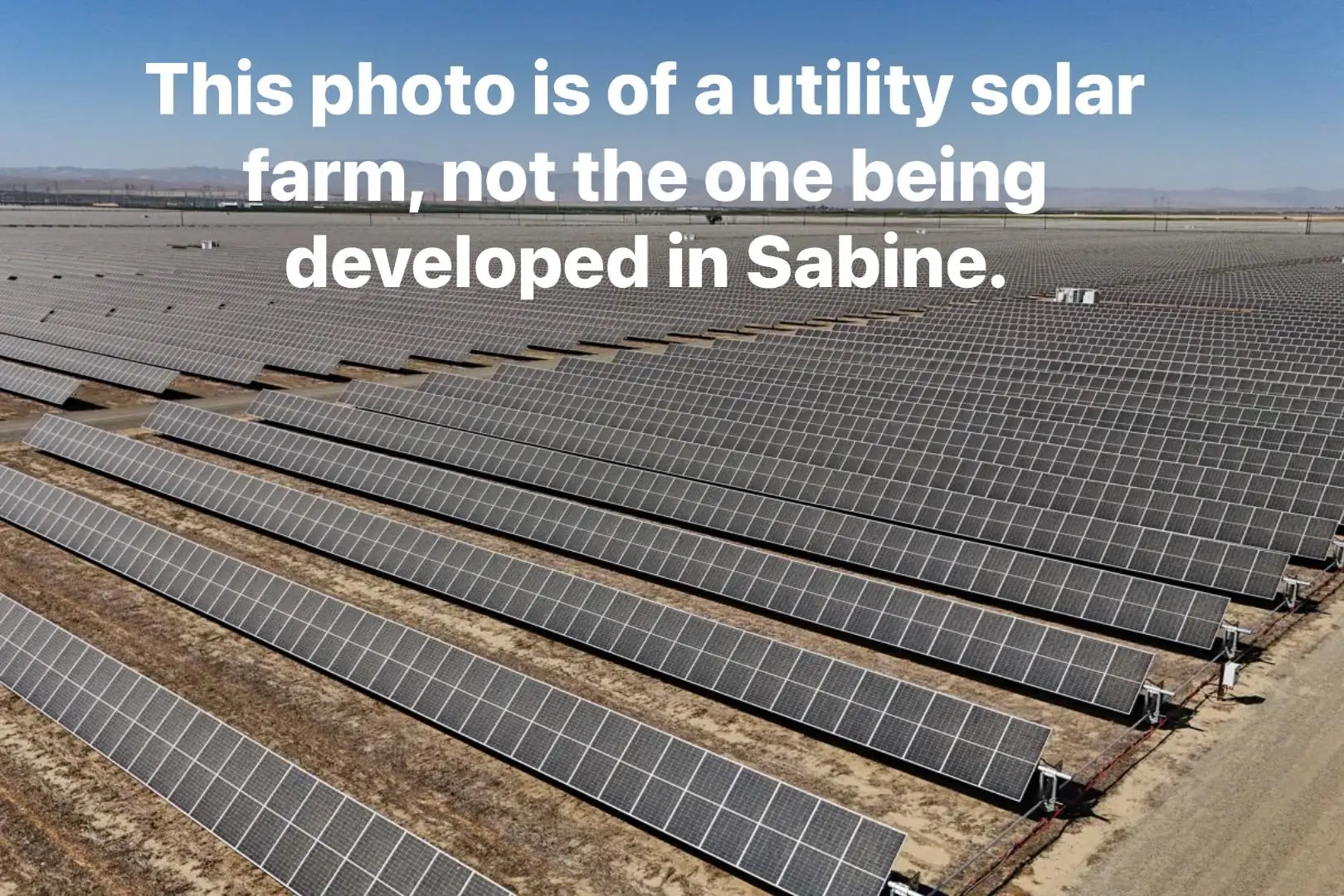
Responding to a follow up question on solar farms. Local resident asked about pros and cons of the huge solar farms, such as the one being built in Sabine Parish near Mt. Zion and the one in planning for land between Many and Fisher.
I received a couple or so complaints that my previous post detailing the Hollis Creek farm was too lengthy. I’ll come back and try to condense but I am an old school journalist who loves research and who believes in the power of details and gained knowledge soooo … with that being said…
The utility scale solar farms are arrays of photovaltaic panels (possibly hundreds of thousands) covering hundreds or even thousands of acres. They generate a modicum of electricity which is tagged as “green” and gets my side eye for that. I’m sure I’m not alone here.
The farms come with notable drawbacks, especially for nearby residents and for ecosystems. Drawbacks stem from
— land conversion (in our case, from timber and forest land… aka, agricultural),
— construction and operations,
— visual and operational changes,
— and long-term life cycle issues.
Concerns have been well documented throughout the U.S. in community complaints, studies, landowner reports, and environmental assessments.
Impacts vary by site, by design (for example, fixed vs. tracking panels… my understanding is that the farm being built by Belmont/Mt. Zion now will be fixed whereas the larger one in planning just north of Many will be tracking panels, which track the sun during the day), by mitigation measures, and by location.
With regards to location, I have come to the conclusion that solar farm projects developed on rural and agricultural land are the most contested.
Residents living nearby report quality of life reductions from the industrial nature of these projects. Among the quality of life reductions:
— Visual and aesthetic intrusions from these vast fields of panels (they are an eyesore, to say the least), security fencing (often 6 ft. With barbed wire), CCTV cameras, and substations. These intrusions transform rural and agricultural views into an industrial landscape. The eyesore that is a solar farm alters property settings and values, affects open country side views, and can harm historic or scenic areas.
— Glare and reflection. Panels produce reflective glares (sometimes described as mimicking bodies of water), potentially affecting drivers on nearby roads, nearby homes, and even aviation. “Solar heat islands” often result, raising the temperatures around the farm (unable to determine yet a range of temp increases… distance and actual temp, but I’m working on it).
— Noise and light pollution. Inverters, tracking monitors, cooling fans (especially in heat), and substations generate ongoing operational noise). Construction brings heavy traffic, dust, and temporary disruption. Light pollution results at night from security lighting. Real world complaints include inveter hum 24-7 which is audible to neighbors.
— Construction impacts. Dust, erosion, road damage from heavy equipment, and increased commercial traffic create short term nuisances and potential health concerns (ie, respiratory issues from dust). Furthermore, road damage is costly to the governing bodies which maintain the roads if there aren’t agreements in place for the contractors / project owners to reimburse for needed road maintenance and repairs.
— Property value concerns. Some studies and appraisale report notable declnes in value— for instance, 5 percent reduction for residential homes within approx. 3 miles, and claims of as much as 25 percent reduction in property values near borders of the farms. In fact, resident opposition to these farms frequently cites value loss as a top issue,
Additional worries include battery storage fire risks (if co-located), and general industrialization of quiet rural areas).
Negatives for landowners affect both landowners who lease their property to developers and those with adjacent or nearby property holdings. Long-term “lock ins” restrict land use availability, often for at least a quarter century. No future farming, harvesting, expansions, residential development, or other opportunities during the lease / project time duration. After project duration / lease period, the land is negatively affected by soil compaction, topsoil loss, and the introduction of invasive species which can delay or in most cases outright prevent a return to productive agriculture.
There are also significant burdens caused by the removal of panels, racking, roads and site restoration… figures I’ve found for restoration are estimated at around $15,000+ per acre or somewhere between $35,000 and $100,000 per MW. Developers usually bear this latter burden via bonds, but shortfalls may hit landowners or taxpayers. Full restoration to original condition is not guaranteed.
Using those figures for the solar farm near Mt. Zion, removing of panels etc may cost at least $34 million, I’m guessing plenty more when we are talking about at least a couple of decades from now.
Furthermore, because prime land is tied up with these projects, there are opportunity costs as higher value uses can be missed through the duration of the project.
For adjacent and nearby landowners, things such as views, dust, traffic and rubnoff can indirectly affect land usabilitiy or values. Runoff / sedimentation from the farm may impact neighboring fields or water features.
Negatives for the environment are severe and plentiful:
— Habitat loss and fragmentation… clearing large areas removes vegetation, disrupts migration cirrodiors, and creates barries (for example, fencing blocks wildlife movement). This affects birds, insects, deer and other species. Also the “lake effect” from the reflective panels can disorient or attract birds, leading to collisions or stranding.
— Soil and land degredation… construction compacts soil, removes topsoil, increases erosion risk, and can promote invasives. Long term shading and management (particularly herbicides) reduce biodiversity and organic matter.
— Water impacts… increased stormwater runoff and sedimentation is a high concern. In arid areas, panel cleaning uses water. Potential leaching of chemicals (dust suppresants, herbicides, or panel materials) into groundwater and streams.
— End-of-line waste… Panels last 25-30 years without any storm damage or other unexpected damage. Recycling rates or minimal at best (possibly less than 10 percent of all items related to the solar panels can be recycled in any sort of way. Improper disposal risks toxic heavy metals (ie, lead, selenium, cadmium) entering landfills or ground water. Decommissioning generates significant non-recycled material.
As far as the positives go for giant solar farms, the main “plus” I found touted for local communities in which they are developed are temporary nice paying construction jobs during the clearing and construction phases. Another benefit is the generation of property taxes or payments in lieu of taxes. I don’t yet know locally how Sabine Parish will fare on these sorts of injections.
Other positives touted for solar farms largely relate to the “green” energy they provide. However, from all I have seen, “green” is nonsensical when considering the costs of a solar farm in a rural area.
Purportedly, solar farms supply electricity to teh grid, potentially lowering costs for locals (should we hold our breath or just accept that this is not terribly likely to happen?… not trying to be a Debbie Downer, but … I think skepticism is warranted.
There are habitat and soil improvements that can be made, such as pollinator-friendly plantings under panels, allowing more insects, birds and native plants. Soil improvements can reduce erosion and support stormwater management.
Lastly, some local governing authorities require agreements with developers to help fund local initiatives (education, health, recreation, etc)