Gandy, which was just south of Florien in Sabine Parish
Information from LUMBERING IN SOUTHWEST LOUISIANA A STUDY OF THE INDUSTRY AS A CULTURO-GEOGRAPHIC FACTOR By George Alvin Stokes A.B., Louisiana State Normal College, 1942 M. S., Louisiana State University, 1949 From McNeese State Library
In 1917 the Wyatt Lumber Company established Gandy, about ten miles south of Many on the Kansas City Southern Railway. By this time much of the longleaf pine timber in the area had been cut, a hardwood mill was installed in addition to the pine mill. Timber was brought in from lands to the west, camps being established at Esto, Negreet, and Bowie. Also at the Gandy mill there was a machine shop, standpipe, lumber yard, and mill pond.
Near the mill the company built a barn and small corral, or “stomp lot,” where four mules used at the mill were kept. Big corrals were maintained at the camps for mules used at the front. Steam skidders were not used here, and the transition in log-handling methods was directly from animal to truck.
Gandy was not large, and in 1930 it was said to have a population of some 350 persons, but in all probability this is somewhat below the number of inhabitants in the town at its maximum size some years earlier.
Boarding houses were provided for white and Negro workers, and schools for the children of both races. A church was built for white residents in their section of the town, while services for Negroes were held in their school building.
Within the town there were the usual mill offices, commissary, post office, and barber shop. A pressing shop was also open for a number of years. Generators at the mill provided electricity for the town, but water had to be taken from dug wells in the yard of each house. Some of these wells about two feet in diameter and lined with cement are still open. Ice was brought in by rail and stored in an ice house at the commissary.
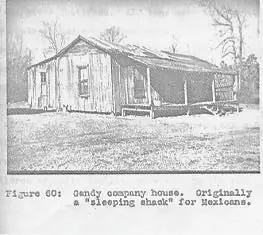
The Gandy population included white, Negro, and Mexican elements. The latter were never numerous, estimates averaging about one hundred, and for the most part they were employed only at heavier manual tasks.
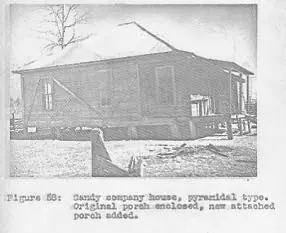
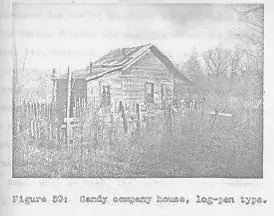
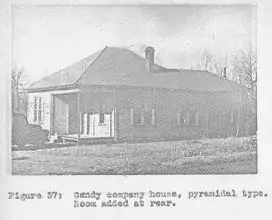
Company houses remaining in Gandy, particularly those built for white families, are large and well-built pyramidal structures, a number of them still being occupied. In some cases alterations have been made, taking the form of addition to the rear of the houses or the enclosure of porches. The houses in the white section of the town were ordinarily painted a buff or cream color. The homes seen the Gandy Negro quarter are of the single log-pen type, unpainted, sturdy and well built.